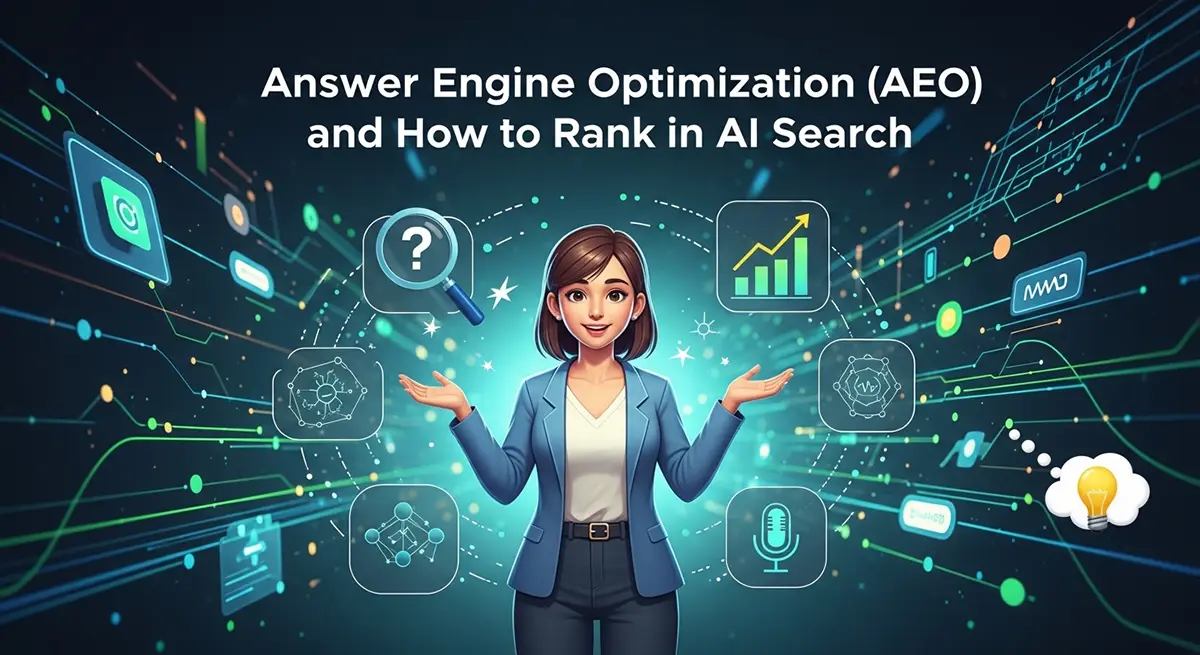
Search is changing fast. People no longer just type queries into Google and scroll through ten blue links. They ask AI tools a question and get one direct answer. That answer comes from a source. That source gets the traffic, the trust, and the lead. This shift is why Answer Engine Optimization is now one of the most important skills in digital marketing.
If you run a business, manage a brand, or work in SEO, you need to understand this now. Not next year. Now.
What Is Answer Engine Optimization
Answer Engine Optimization is the practice of structuring your content so that AI-powered search tools cite your website as their source. These tools include ChatGPT, Claude AI, Google’s Search Generative Experience (SGE), Perplexity AI, and Microsoft Copilot.
Traditional SEO helps you rank on a search results page. Answer Engine Optimization helps you become the answer itself.
When someone asks ChatGPT “what is the best digital marketing agency in Sharjah,” the AI pulls from content it has processed. It looks for clear, credible, well-structured information. The brands and pages that match those signals get mentioned. The ones that don’t get ignored.
This is the core idea behind Answer Engine Optimization. You are not optimizing for a ranking position. You are optimizing to be chosen as the trusted source.
Why Answer Engine Optimization Matters Right Now
Google still dominates search. But the behavior of users is shifting quickly.
Studies show that a growing percentage of online users now get their answers directly from AI tools without clicking any links. This is called zero-click search. It means that even if your site ranks number one on Google, you may be losing traffic to an AI that summarizes your content and presents it as its own answer.
ChatGPT crossed 100 million users in record time. Google SGE is now rolling out across global markets. Perplexity AI is growing rapidly as an alternative search engine. These are not experiments. They are the future of how people find information.
If your content is not structured for Answer Engine Optimization, you are invisible to a growing portion of your potential audience. That audience is not going back to traditional search behavior.
How AI Answer Engines Work
To optimize for something, you need to understand how it works.
AI answer engines do not crawl the web in real time the way Google does. Most of them are trained on large datasets of text from across the internet. They learn patterns of what makes a good answer. When a user asks a question, the AI generates a response based on that training data.
Some tools, like Perplexity AI and Google SGE, also do live web retrieval. They pull current pages, scan them quickly, and summarize the most relevant content. In these cases, your page has a direct chance to be cited in the response.
What they all have in common is a preference for content that is clear, direct, and structured. They favor content that answers a specific question in the first few sentences. They favor content that uses natural language, headings, and short paragraphs. This is the foundation of Answer Engine Optimization.
The Step-by-Step Answer Engine Optimization Framework
Step 1 – Build a Question-First Content Strategy
Every piece of content you create should start with a question. Not a topic. A question.
Instead of writing an article titled “Digital Marketing Tips,” write one titled “What Digital Marketing Strategies Work Best for Small Businesses in the UAE.” That is how people talk to AI tools. They ask full questions.
Use tools like AnswerThePublic, AlsoAsked, or Reddit to find real questions your audience is asking. Then build content that answers each question directly and completely.
Your first paragraph should contain the answer. Do not bury it after three paragraphs of introduction. AI tools scan for fast answers. Give them one immediately.
Step 2 – Structure Your Content With Clear Formatting
AI tools love structure. Use H2 and H3 headings generously. Use bullet points and numbered lists. Break long ideas into short sentences and short paragraphs.
This structure makes it easy for an AI to extract the specific part of your content that answers a user’s query. If your content is one long block of text, the AI may skip it entirely.
Use FAQ sections at the bottom of every article. Format them as real questions with concise answers. Google SGE in particular pulls heavily from FAQ-style content when generating its summaries.
Include a table or comparison chart where relevant. Structured data formats are easy for AI to read, summarize, and cite.
Step 3 – Use Schema Markup
Schema markup is code you add to your website that helps search engines and AI tools understand what your content is about. There are specific schema types that are powerful for Answer Engine Optimization.
FAQPage schema tells AI tools that your content contains questions and answers. HowTo schema signals that your content is a step-by-step guide. Article schema establishes your content as editorial information from a credible publisher.
Adding these to your pages gives AI tools clearer signals about what your content contains. This increases the likelihood of being cited in AI-generated answers.
Step 4 – Build Authority and Trust Signals
AI answer engines prefer content from credible sources. They look for signals of trust and expertise. This is where off-page SEO and brand building intersect with Answer Engine Optimization.
Get your business cited in local news outlets, industry blogs, and reputable directories. Build a strong presence on platforms like LinkedIn. Earn backlinks from authoritative websites in your niche. These signals tell AI tools that your brand is a reliable source of information.
In the context of Google SGE, E-E-A-T (Experience, Expertise, Authoritativeness, Trustworthiness) is still a major ranking factor. The same principles apply to how other AI tools evaluate content quality. Show real expertise. Use author bios with credentials. Link to primary sources and data.
Step 5 – Optimize for Conversational Language
People talk to AI tools like they talk to a person. They use natural, conversational language. Your content should match that tone.
Write the way your customers speak. Avoid jargon where possible. If you use technical terms, explain them immediately. Write short sentences. Use plain words.
This is not just a style choice. It is an optimization decision. AI tools are trained on natural language. Content that sounds human and conversational is easier for them to process and reproduce in an answer.
Step 6 – Target Featured Snippet Positions
Google SGE pulls heavily from featured snippet content. If you already rank for featured snippets on Google, you are in a strong position for AI-powered search as well.
To win featured snippets, answer a question in 40 to 60 words directly under your H2 heading. Use a clear, tight definition or explanation. Follow it with more detail. This format signals to both Google and AI tools that you are providing a precise, trustworthy answer to a specific query.
Real Examples of Answer Engine Optimization in Action
ChatGPT often cites educational and informational websites when users ask how-to questions. If you ask ChatGPT how to create a social media strategy, it may reference marketing blogs that have detailed, step-by-step articles. Those blogs rank because they match the question format, are structured clearly, and are trusted sources.
Claude AI tends to favor balanced, well-researched content. It references pages that provide nuanced explanations rather than promotional content. If your blog posts are genuinely helpful and not stuffed with sales language, Claude is more likely to cite them.
Google SGE frequently shows summaries at the top of search results for informational queries. Below the summary are three or four cited sources. Those sources have clear headings, short paragraphs, FAQ sections, and schema markup. They follow the exact Answer Engine Optimization principles outlined in this article.
Answer Engine Optimization vs Traditional SEO
These two approaches are not in conflict. They work together.
Traditional SEO still matters. Google still drives enormous volumes of traffic. You should not abandon keyword research, link building, or technical SEO.
But Answer Engine Optimization adds a new layer. It ensures your content is built for the next generation of search, not just the current one.
Think of it this way. Traditional SEO helps you rank on a page that users scroll through. Answer Engine Optimization helps you become the answer that users never scroll past.
Where to Start
If you are new to Answer Engine Optimization, start with your existing content. Audit your top-performing pages. Ask yourself if each page answers a clear question in the first paragraph. Add FAQ sections. Add schema markup. Rewrite your headings as questions where it makes sense.
Then build new content using a question-first strategy from the start. Track which pages get cited by AI tools using brand monitoring tools. Adjust your approach based on what works.
The brands that invest in Answer Engine Optimization today will be the ones that dominate AI search tomorrow. This is not a trend to wait on.
Final Thoughts
Answer Engine Optimization is the next frontier of digital visibility. As AI tools replace the traditional search experience for millions of users, the rules of content marketing are changing. Clear structure, direct answers, trusted sources, and conversational language are the new ranking signals.
Your content either becomes the answer or it becomes invisible. The choice is made in how you write, structure, and position your content right now.
Start optimizing for answer engines today and stay ahead of the shift.