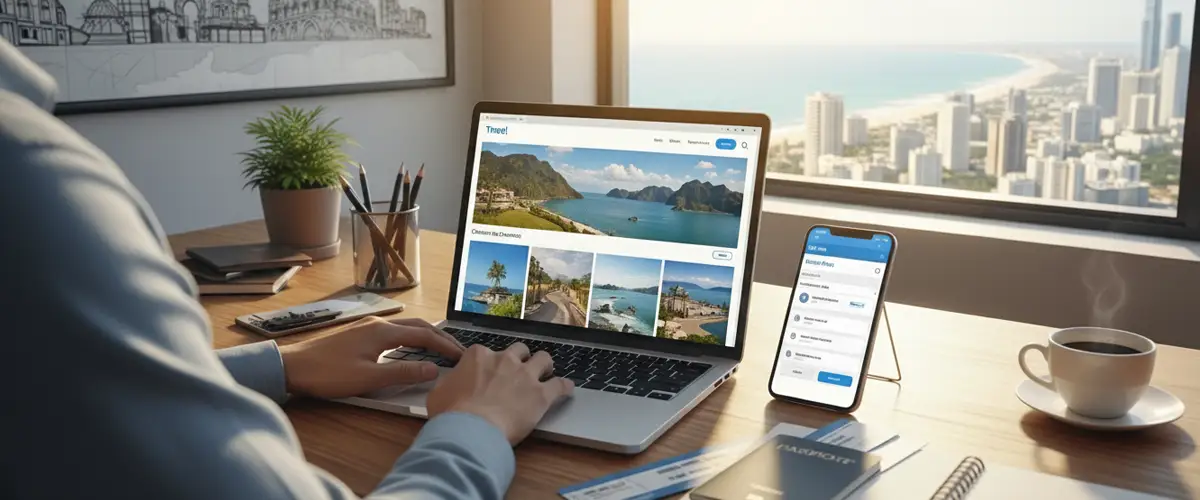
If you run a travel agency in the UAE and your website is not showing up on Google, you are losing real money every single day. Travelers in Sharjah, Dubai, and Abu Dhabi are searching online for holiday packages, visa services, and flight deals right now. This SEO guide for travel websites will show you exactly how to get in front of those people before your competitors do.
The numbers for 2026 are clear. Over 83% of travelers start planning with an online search. Google now processes more than 14 billion searches every single day. And here is something that might surprise you. Travel is one of the industries where Google’s AI Overviews appear most often. That means the rules have changed and you need to know what to do about it.
This guide keeps things simple. No confusing tech language. Just practical steps you can start using this week.
Why Every Travel Agency in the UAE Needs an SEO Guide for Travel Websites in 2026
The travel industry in the UAE is more competitive than ever. You are not just competing with the agency on the next street. You are up against massive platforms like Booking.com, Expedia, and TripAdvisor.
But here is what gives small agencies a real advantage. Big platforms chase broad keywords. You can win by targeting the specific searches your ideal customers are typing. Phrases like “family holiday packages from Sharjah” or “Maldives honeymoon deals UAE 2026” are searches where a focused travel agency can genuinely outrank the giants.
Organic search still drives around 40% of all travel website revenue. That is consistent, free traffic that does not stop the moment you pause a paid campaign.
This is exactly why smart travel agency owners across the UAE are now working with professional SEO Services in Sharjah and Digital Marketing Services in Sharjah to stay ahead of the curve.
The Big Change in 2026: AI Overviews and What They Mean for You
Before we get into the step-by-step SEO guide for travel websites, you need to understand something important that changed search completely in 2025 and is now in full effect in 2026.
Google now shows AI-generated summary answers at the very top of many search results pages. These are called AI Overviews. Instead of just showing a list of website links, Google reads multiple pages and writes a summary answer right there on the results page.
Research shows that travel is one of the most affected industries. AI Overviews now appear in a very high percentage of travel-related searches. Studies show that when an AI Overview appears, click-through rates drop significantly compared to traditional results.
So what does this mean for your travel agency website?
It means your goal is no longer just to rank on page one. Your goal is now to become a trusted source that Google’s AI actually reads and cites in those summaries. If Google’s AI quotes your website, travelers see your agency name before they click anywhere. That is massive brand visibility.
To get cited in AI Overviews you need to write clear, factual, well-structured content that directly answers travel questions. Short paragraphs, clear headings, real information from genuine experience. Generic content written just to fill pages will not work anymore.
Step 1: Do Your Keyword Research the Right Way
Before you write a single word on your website, know what your customers are actually searching for.
Most travel agencies make the same mistake. They target big keywords like “Dubai holidays” or “cheap flights.” These are nearly impossible to rank for because massive companies dominate them. The smarter path is long-tail keywords.
Long-tail keywords are longer, more specific phrases. They have lower competition and higher buying intent. Someone searching “5-night Maldives package from Sharjah with flights 2026” is far closer to booking than someone just searching “Maldives.”
Here are the keyword types that work best for UAE travel agencies:
- Destination-specific keywords like “best honeymoon packages from UAE 2026”
- Service-based keywords like “visa assistance services Sharjah”
- Seasonal keywords like “Eid Al Adha holiday packages UAE”
- Local keywords like “travel agency near me Sharjah”
- Experience-based keywords like “adventure tours from Dubai for families”
Free tools like Google Keyword Planner and Ubersuggest are good starting points. For deeper research, Semrush and Ahrefs show you search volume, keyword difficulty, and what your competitors are ranking for. Semrush’s Keyword Gap tool is especially useful because it shows keywords your competitors rank for that your website does not yet target.
Once you have your keywords, assign one primary keyword to each page. Never target the same keyword across two different pages.
Step 2: Fix Your Website Speed and Mobile Experience
If your website takes more than three seconds to load, most visitors will leave before they even see your offers.
Travel sites in 2026 average a 4.2-second load time. But the best-performing ones load in under 2 seconds. That gap is where bookings are won and lost.
Think about your typical UAE customer. They are on their phone during a lunch break in Sharjah, looking at holiday options. If your site is slow or hard to read on a small screen, they close it and open a competitor’s page. Research confirms that 73% of travel searches happen on mobile devices. Mobile is not optional anymore.
Here is what your website needs to get right:
- Pages that load in under 2 seconds on mobile
- A clean, readable layout that works on any screen size
- Buttons that are easy to tap without zooming in
- No unnecessary pop-ups blocking your content
- Images saved in WebP format for faster loading
- Descriptive alt text on every image so Google understands what it shows
That last point about images matters more than most agencies realize. Compressed WebP images dramatically reduce page load time without losing visual quality. Good alt text also helps your images appear in Google Image search results, which is another source of free traffic.
Step 3: Write Content That Google and Travelers Both Trust
In 2026, Google evaluates your content using what it calls E-E-A-T. That stands for Experience, Expertise, Authoritativeness, and Trustworthiness. Google updated these guidelines significantly and the message is very clear. Content written from genuine, first-hand experience ranks better than content that is generic and surface-level.
For a travel agency, this is actually great news. You have real knowledge about destinations, visa processes, booking tips, and travel experiences that a generic website or AI tool cannot replicate.
Write content that answers the real questions your customers ask you every day. Some content ideas that rank well for travel websites:
- Destination guides like “Complete Guide to Georgia for UAE Families”
- Practical tips like “Schengen Visa Requirements for UAE Residents 2026”
- Comparison posts like “Maldives vs Bali for a Honeymoon from Dubai”
- Seasonal content like “Top Destinations for UAE National Day Long Weekend 2026”
- Honest posts like “What First-Time Travelers to Europe Get Wrong”
Write the way you would explain something to a friend. Short, clear sentences. Real advice. No fluff.
One more thing that matters in 2026. Original photos from actual destinations your team has visited are now a significant trust signal for Google. Stock photos are easy to spot and they do not demonstrate real experience. Authentic images with location data prove you have actually been there.
Step 4: Use Local SEO to Win Searches Near You
If your agency is based in Sharjah, local SEO is one of the most powerful tools you have. When someone nearby searches for a travel agency, Google shows results based on location. That map with three business listings that appears near the top of the results page, that is called the Local Pack. Only actual local businesses can appear there. Big platforms like Expedia cannot.
Start by claiming and fully completing your Google Business Profile. Fill in everything. Your business name, address, phone number, working hours, photos, and a description that mentions what you offer and where you are located.
After that, ask satisfied customers to leave reviews. Research shows that Google’s local ranking is based on three things: relevance, distance, and prominence. Reviews directly build your prominence score.
Also make sure your business name, address, and phone number appear exactly the same on your website, your Google profile, and any other directory where your agency is listed. Even small differences confuse Google and hurt your local ranking.
Step 5: Build Your Website Authority with Quality Backlinks
A backlink is when another website links to yours. Google treats it like a recommendation. The more trusted websites that link to you, the more Google trusts your site.
Backlinks remain one of the strongest ranking signals Google uses. Research from multiple SEO studies consistently shows that 92% of marketing professionals believe backlinks will continue to be a major ranking factor.
But quality matters far more than quantity in 2026. One link from a respected UAE travel publication or news site is worth far more than a hundred links from random directories.
Here are honest ways to earn good backlinks for your travel agency:
- Write guest articles for UAE lifestyle or travel blogs
- Get listed in legitimate UAE business directories and tourism boards
- Partner with hotels or tour operators who can mention your agency on their site
- Create genuinely useful content like a UAE travel checklist that others want to link to
- Build relationships with travel influencers who create content for UAE audiences
Never pay for links from bulk link sellers. Google’s systems detect this reliably and the penalty can push your website off Google completely.
Step 6: Add Schema Markup to Help Google and AI Understand Your Pages
Schema markup is a small piece of structured code you add to your pages. It tells Google and AI systems exactly what your content is about. This is more important in 2026 than it has ever been.
Research confirms that most travel agency websites have zero schema markup. Adding even the basics immediately puts you ahead of most local competitors.
For travel websites, schema markup helps Google display rich results in search. These can include star ratings, package prices, review scores, and FAQ answers appearing directly in the results before anyone clicks your link. This makes your listing stand out and gets more clicks.
Useful schema types for UAE travel agencies include:
- TravelAgency schema for your business information
- TouristTrip schema for your tour and package pages
- FAQ schema for common traveler questions
- Review schema for customer testimonials
- VideoObject schema if you have destination videos
Use Google’s free Rich Results Test tool to check that your schema is working correctly.
Step 7: Track Your Results Every Month
SEO is not something you set up once and forget. It is an ongoing process that needs regular attention.
Set up Google Analytics 4 and Google Search Console for your website. Both tools are free. Google Analytics 4 shows you how many people visit your site, where they come from, and what actions they take. Google Search Console shows you exactly which keywords bring people to your pages and alerts you to any technical issues.
In 2026, there is one additional metric worth tracking. How often is your agency mentioned or cited in AI-generated answers on Google, ChatGPT, or Perplexity? This is becoming a real indicator of your brand’s authority in the travel space. Some tools like Semrush and Ahrefs are now beginning to track this type of AI visibility.
Check your data every month. Update old content to keep it accurate and fresh. Add new destination pages as your business grows. Watch which pages are driving bookings and invest more effort in similar content.
How Lumrah Media Helps UAE Travel Agencies Grow with SEO
Managing all of this while running a busy travel agency is a lot to handle. Most agencies start seeing real SEO results between three and six months after getting the foundations right. The key is consistency.
At Lumrah Media, we provide SEO Services in Sharjah and Digital Marketing Services in Sharjah built specifically for UAE businesses. We understand how travelers in this region search, what motivates them to book, and what it takes to rank in a competitive market.
Whether you need a full SEO strategy, content writing, technical website fixes, or monthly SEO management, the team at Lumrah Media is ready to help your travel agency grow.
Final Thoughts
Getting your travel agency to rank on Google in 2026 is absolutely achievable even in a competitive market. You do not need the biggest budget. You need the right strategy and consistent effort over time.
Follow this SEO guide for travel websites one step at a time. Fix your site speed. Research the right keywords. Write genuine, helpful content. Own your local search presence. Earn quality backlinks. Add schema markup. Track your results.
Do those things consistently and your website will attract travelers who are ready to book, not just browse.
If you want expert support from a team that understands the UAE market, reach out to Lumrah Media today. Our Digital Marketing Services in Sharjah are designed to deliver real, measurable results for travel businesses just like yours.